Welcome to the Dark Side!

We are writers mainly from Australia and New Zealand who write speculative fiction with romantic elements. Be it fantasy, paranormal, dark urban fantasy, futuristic and everything in between.
Showing posts with label author. Show all posts

Saturday, 23 March 2024

DarkLight On...Samantha Marshall!


Welcome to Samantha!


How did you come to write speculative fiction / spec-fiction romance? What attracted you to the genre?

I don’t remember ever making a conscious decision to go in that direction; I think the simplest answer would be to say I was forged there. Magic is in my bones, dragon’s fire burns in my lungs, unicorn blood pumps in my veins - you know, the usual. While other children dreamt of dolls and trucks, I dreamt of werewolves and spaceships. There’s a famous quote by Roald Dahl that goes something like: “Those who don’t believe in magic will never find it.” I like to think if I believed in it any more, it might find me for a change! My grandmother taught me to see the fairies in her garden when I was incredibly small, and together we made them tea in tiny, upside down gumnuts. My Mum (hi Mum!) plied me with endless books, from classics like Winnie the Pooh and Martha B. Rabbit all the way through to The Silver Brumby, The Dragonriders of Pern, The Discworld, and The Psy-Changelings. When it came to writing, I wanted to take what I felt inside and share it, hoping, in the process, that it allowed someone else to enjoy the same kind of wonder I’d been able to experience.


Tell us about being involved with the Perfectly Paranormal Anthologies?

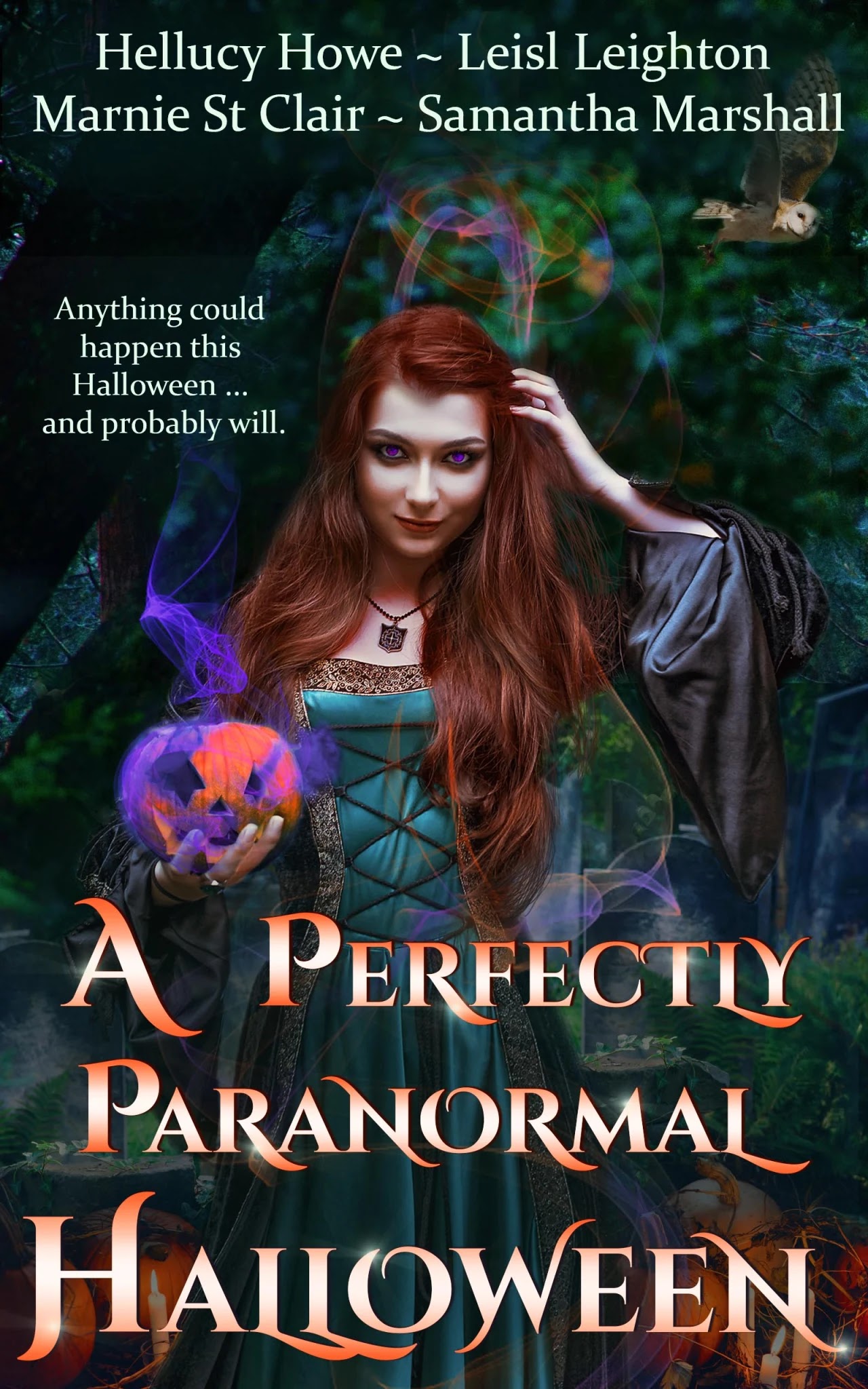
Oh! I love all my APPA ladies. What a ride that’s been. We’re fortunate enough to be incredible friends, with a really wonderful spread of not just creative talents but back-end talents too - which has enabled everyone to give the perfect amount of caring and support when it comes time to pull everything together. I think our biggest issue as a group has been keeping Leisl and I inside the word count (heh, sorry, not sorry?) as we have a habit of writing at maximum verbosity at every available opportunity. My challenge for Season One (which is how we affectionately refer to the first four) was to explore deliberately adding comedy to my work for the story as a whole, rather than just in moments. I’d been thinking about it for a while, but I’d been worried about the story turning slapstick or silly and I didn’t want to sacrifice potential depth in either character or plot to gain a cheap laugh. As a Discworld fan, I knew it could be done, and the novella format gave me the perfect opportunity to try it out without the pressure of a full length book hanging overhead! Having a chance to experiment with new things and hang out with close writer friends while we breathe life into something new and amazing on a regular basis has been both an awesome adventure and an honour. I can’t wait for Season Two! (Wait… what?? Spoiler alert!)



Are you a plotter? Panster? Or somewhere in-between?

Oh gods. Haha. So, I never know how to answer this question. I’m like… Indiana Jones. How’s that? (So useful. At least I’m sexy, right?) Okay, okay. It works like this:

- I always have my two main characters fully fleshed out. My ideas usually start with them. If I start with a situation, let’s say, a sudden desire to open a business manufacturing paintbrushes made from unicorn tail hair, then one of the characters will be said unicorn using her own hair to craft the brushes from. Why? She wants to save the sables. Leave them all alone, people. Her brushes are better. Now her opposite is going to be… an artist. He paints tabletop RPG minis on video based social media platforms that shall not be named for copyright reasons for a living, and he needs a new set of perfect brushes. He agrees to trial and error her brushes from conception to finalisation on live stream in exchange for a custom set once they’re done, and she gets free advertising out of it. 

- We now have the basis for a plot, characters, and close proximity. There clearly must be a nemesis, obstacles, a happily ever after, a throbbing brattwurst encounter (most likely in a paint studio) and given at least one of the MC’s is a unicorn, a healthy dose of shape-shifting. I’ll also need to decide what, if anything, species or magical abilities our artist has. 

- Do I decide any of those things before I start? NO. This is what my mentor at uni used to call ‘writing into the dark,’ and the image upon which I have based my affectionate coinage of the Indiana Jones description. As far as I’m concerned, what I’ve done above is plotting. I’m not really making this up as I’m going along; I fleshed the idea out before I started. Or… the shell of it at least. I think of myself now as Indiana Jones (or Lara Croft, if my boobs were ever so blessed) with a vague idea of the ancient temple in his mind and a flaming torch in hand, illuminating the incredible, intricate labyrinth as he goes. Sometimes, the way is perilous and he has to progress slowly (especially if someone blows his torch out and he has to spend time trying to light the darn thing again) and sometimes, there’s a rock chasing him and he has to run as fast as he physically can while screaming incoherently and flashing a bizarre amount of oiled chest for no apparent reason, but gods dammit, that torch which seemed so fragile before will not go out for ANY REASON, so run while you can! It’s amazing the little offshoots and unexpected surprises that can be discovered in this way; just enough shape to give structure but not so much that I feel bound by it. Of course, this is also how my books end up being long, but hey; I like to think of it as value for money.


Do you have a favourite of your characters?

I like different characters for different reasons, but there are a few who like to jostle around near the top position. I’m very partial to Raiden, from ‘The Heart of a Shadow.’ He’s strong and soft, and incredibly dedicated almost to the point of naivety. I love him for that. I’m almost equally attached to his opposite, Lyria, and her perfect inhumanity. I also adore Fenris and Flare, from the ‘Sorcery and Stardust’ series. Fenris is my dark and broody, and Flare is all about being threatened with a good time on the outside, with a marshmallow interior. There’s another character in this series, too, who you haven’t met yet - but I can’t wait until you do. Honestly, there are so many - I could go on and on and on and on!


What are you currently working on?

Currently I’m working on book two in the Merged Worlds series, which follows on directly from ‘The Heart of a Shadow.’ It’s in the very early stages yet, but we’ll be following some new characters on their journey as well as hanging out with some old favourites! :)


What can we expect from you in the future?

That’s a great question. When I work that out, I’ll let you know! (Runs as fast as possible)

Haha. 

On a more serious note, I’ve recently had a fair bit of time off (or very much slowed down) due to my health, and it’s forced me to take a bit of a step back and re-evaluate the way I was doing things, and what both my short term and long term objectives are. I felt like I’d grown up surrounded by magic, but that somewhere along the way, I’d let someone (nameless, faceless someone, don’t worry) convince me that it was time to ‘grow up’ and be a ‘real author’ now, and in order to do that, I had to let the magic go. And… if I don’t have the magic inside me, then how can I share it? I’m made of magic - if I banish it, what’s left of me? 

(Oh dear, she got serious. Quick, someone rewind!)

It’s been an interesting period of introspection, to say the least; and no, I haven’t been as kind to myself as I should have been, but I think sometimes that’s part of the purging. What’s important is that I came to the decision that whether or not it might be deemed fundamentally correct, I am the magic and the magic is me, and going forward, that will be at the core of who I am both as a person and a writer. 

So, eventually, you can expect books, obviously. 

In… a magical way?

I don’t know.

Glitter!


Do you have advice for emerging writers?

- Believe in yourself. 

- Never stop practicing. 

- Remember that an author’s career is a marathon, not a sprint. 

- Ice cream is a valid meal choice.


What are you currently reading/watching?

- Watching Halo, Season 2 with my husband

- Reading the Breed Series, by Lora Leigh

(Mum recommended these to me to try. ((Hi mum!)) I’m up to about book seven, I think? Anyway, the earlier books haven’t aged particularly well and tend to be a bit chauvinistic which grates on my nerves, but the premise is interesting from a paranormal and shifter perspective. I believe the original publisher was very keen on the domineering male sort of tropes, so there’s that. As the series progresses, the tone of the writing changes and there’s a little less caveman grunting and a little more intelligent conversation, which is refreshing. Anyhow, I’m considering the series a matter of research, as anything that’s 34-odd books long and still incredibly popular is worth decoding in order to try and understand why!)


Thanks Samantha!

~~

Check out The Heart of a Shadow

Prince of Storms.
Lady of Shadows.
God of Chaos.

Bound in eternal servitude to the Atlantean royal family, dark fairy Liria Atlannon spends her days bending to the whims of her mistress. When Atlantis’ youngest Princess announces her betrothal to the great Pharaoh Taos of Egypt, Liria has no choice but to follow her Princess across the sea to a kingdom – and a life – unlike anything she has known before.

As Commander of the Pharoah’s honour guard, it is Prince Raiden Horushood’s duty to defend his brother at all costs. He’s never met a foe he couldn’t conquer –  until Set the Anarchist, god of war and chaos, attempts to steal the Pharaoh’s fiancee from her own welcome banquet. While Raiden rages helplessly in the thrall of Set’s magic, Liria, the softly spoken handmaiden who spends most of her time staring at the floor, not only turns Set away but injures him in the process.

With the threat of an unpredictable god hanging overhead, Raiden begs Liria to join the Pharoah’s honour guard. Though Liria aches to become part of something greater, self preservation dictates she stay away from the vital, strong, and irritatingly handsome Prince Raiden. For if the warrior angel gets too close, he’ll discover that the biggest threat to Merged Egypt is not Set at all – it is Liria Atlannon, damned by the magic which shackles her soul, steals her free will and shapes her actions… until all that remains is a shadow.

Buy


Samantha Marshall

Hello! 

My name is Samantha Marshall and I’m an author of speculative fiction, a mother to two tiny dictators, an artist, a keen drinker of chai tea and, in my spare time, a unicorn.

I’ve been living stories as long as I can remember, telling them from the moment I could talk and writing them from the moment I could clumsily grip a crayon. Where I go, stories follow, like glitter on concert night. I see potential in things both strange and normal, am struck by inspiration in often unlikely places.

I believe in writing to the best of my ability, breathing life into my characters, always pushing the proverbial envelope, and dragons.

Won't you come on a ride?


You can find Samantha at her website: sliceofsammy.com


Monday, 21 November 2011

Magic Monday - Are you a paranormal groupie?

(a special Magic Monday this week, from Kylie Griffin)

You know you're a paranormal groupie when....

  • ...you can reel off the meanings of an acronyms such as DUF, F&F, UF, SF/F/P, HF, EF, PR, BPS, FU and varying combinations with alacrity
  • …you hear a strange sound and immediately reach for your backpack (which, incidentally, contains a wooden stake, holy water, a hand gun with silver bullets, a communicator, a phaser, a spell book for all occasions, a variety of amulets and lucky charms, an almanac of alternate realities, a handy pocket sized dictionary of demonic languages, a crystal ball with matching tarot cards and a ring of magic keys) and you head straight for the location you last heard it shouting, "Go ahead, make my day, hell-spawn!"
  • ...you think it's normal to open conversations about demons/vampires/shape-shifters/psi-powers/alien races in mixed company
  • ...you understand that “succubus/incubus” have plurals and that they’re “succubi/incubi”
  • ..."Live long and prosper" (accompanied by the traditional hand sign) is your standard farewell
  • …all the clothes you own are variations in the color black
  • ...you've made weapons out of your garden implements...just in case, because the next door neighbour's kid gives new meaning to the word holy terror
  • …when you hear the words “Exorcizamus te, omnis immundus spiritus, omnis satanica potestas, omnis incursio infernalis adversarii, omnis legio, omnis congregatio et secta diabolica, in nomine et virtute Domini Nostri Jesu + Christi…” and realize you aren’t at a baptism or partaking in Holy Communion
  • ...you realize the danger of shouting the expletive phrase “Suck me!” in a nightclub with people with pallid skin and who claim pointed canine teeth are the latest “vamp” trend
  • ...you can reel off every known class of starship from Earth to the Delta Quadrant without drawing breath
  • …the newest release of Keri Arthur/Mel Teshco/Sherrilyn Kenyon/(insert other fav.author) excites you more than sex does
  • ...you wear steel-capped boots, a long leather jacket, and an array of hidden weapons on your person when you step outside your house
  • ...the saying “his/her eyes turned red” can hold so many different meanings (not all of them good)
  • …your significant other plays the opening tunes to Star Trek/The Twilight Zone/Blood Ties/(insert other favourite program here) just to get your attention
  • ...you believe it makes perfect sense to decorate you house with necklaces of garlic, hang mirrors in every room, install fonts of holy water at every entrance, and burn twists of sacred herbs 24/7
  • ...the phrase “TRUST NO ONE” isn’t just an X-Files quote
  • …the word “World Con” has you salivating in 3 seconds flat
  • …an earthquake shakes your house and you dive for cover shouting, "Take cover! The Hellmouth is opening, the Hordes of Baccus begin the Reclamation!" and everyone else looks at you as if you’ve gone mad
  • …you understand exactly what the phrase ‘seduced by an succubus’ means and that it may be less alluring than it sounds
  • ...you find yourself translating magazine articles in waiting rooms (out loud) in fluently Elvish, Pernese or Klingon just to pass the time
  • …you think it’s normal to name your child Buffy, Angel, T'Pol, Tiberius, Acheron, Wrath, Sookie or after various pantheon deities
You know you're a paranormal groupie when...you immediately send this list to other paranormal groupies, here and overseas, realizing that only they will understand!

Can you think of any other signs or symptoms I might have missed? :-)

Monday, 10 October 2011

Magic Monday - Is your manuscript ready?

(Magic Monday =  a little something extra this week from Kylie Griffin)

It's that time of year again, contest divas! The RWAustralia Emerald contest for unpublished authors is just around the corner.

Have you polished and edited your manuscripts? I hope so because The Emmy wants you!!!

For anyone who's not a member of RWAustralia, this is THE major contest for anyone who writes category or single title romance.

The whole contest is designed to mirror the submission process an author goes through when sending off their work to agents or publishing houses. The first two rounds are scored and judged by readers, while the final round is read by an acquiring editor from a major publishing house (usually from the USA).

Round 1 - the first 18pgs of your manuscript in ARC format
Round 2 - submit the full manuscript
Round 3 - three finalists from each section (category & single title) will send their full manuscript to an editor for final placement

# Opening date October 28th 2011
#Closing date November 25th 2011

Places are awarded for the separate category and single title sections but results aren't announced until the August RWA conference.

* Entry forms and details on how to enter can be found on the Contest page of the RWAustralia website.

So, what's so good about entering the Emerald?

Check out what previous entrants and place-getters have said about their experiences... 

"The Emerald was great for my writing journey in several ways. Firstly, it gave me deadlines to work to, which provided structure to my writing year.
It also gave me really interesting feedback, because it came from readers - the people we're writing for. And not just on the first 3 chapters - they could tell me what they thought of the whole manuscript, all the way to the Happily Ever After. Both wins also started dialogues for me with editors, not for the line I eventually sold to, but fabulous feedback and experience.
Such a great contest and resource for writers!" (Rachel Bailey) 

"Finalling - and then having to finish the ms that I'd supposedly finished before entering within 10 days really made me focus! 
Although that book wasn't the one that got me published (and I do hope to have it pubbed someday soon) :-) it gave me the kudos to be headhunted to do a Masters in Writing at Qld. University of Technology. That was a huge ego boost and validation that what I was writing wasn't complete crap (which I suspect just about every writer wonders about from time to time).
I really appreciated the feedback I got from the Emerald. It's a great contest." (C.C.Coburn) 

"Where do I start? :-) This was great for me as an entrant, because it gave me a taste of the publishing world : mainly, writing to a deadline, which is probably one of the most important abilities for a published author (other than producing a saleable manuscript!) And of course, a chance to hit an acquiring editor's desk.
I was thrilled when I finalled and could tell the editor that the first chapter of that same ms was on one of her assistant's TBR pile due to another RWA comp. So the Emerald helped by giving me a deadline to work to, plus impetus to actually finish a complete manuscript (before then, I'd been writing 3 chapters max.)." (Paula Roe) 

"The very first contest I entered was the Emma Darcy which, like the Emerald, was for completed manuscripts. It was life changing. Someone other than my beautifully biased husband and family had connected with my story, my characters, my voice. Wow! I finalled in that contest - very powerful motivation that sustained me when rejection letters from publishers started turning up...
Subsequent Emerald feedback helped me learn my craft. Yes, criticism can sting, but if you look back at it in a couple of weeks there will be kernels of truth. If two or more judges have identified the same thing, chances are they're right...
The Emerald gives you a goal to aim for during the year. It gives you a taste of the submission process you'll spend your writing life following. Most importantly it gives you an anonymous audience who will give you genuine unbiased feedback! So get writing and good luck." :-) (Helene Young) 

"I love entering the Emerald because the judges are readers, rather than contest judges who are writers. Readers, even in the first round, give you a different insight into whether the book is a good read or not, and if they enjoy your characters and your plot, rather than getting bogged down on writing type details. Readers give an overall perspective on how well a story might do on a published market.
 If theses judges say they want to read more, you know you've hooked their interest and are on the right track. If they say they were bored to tears, you know to cut out backstory and increase the conflict and drama. Then, if you' re lucky enough to make it into the second round, Emerald judges comment on the completed book, which is truly rare in contest circles.
The author then knows if the conflict is strong enough and the story arc complete enough, to hold a readers interest and make the book ready for submission to agents or editors. But either way, it makes you push yourself to write, edit, and polish an entire book, not simply the opening chapters." (Suzi Love)

"The Emerald Contest is the successor to the wonderful Emma Darcy Award, which I won in 2005, the last year of the contest. I withdrew from the 2006 Emerald because I'd sold my book - a nice reason!
I know as an unpublished writer, it was often difficult for me to soldier through and finish a manuscript. I still have numerous 'stumps' under the bed, stories I started with great enthusiasm and then decided weren't viable. So I'd start something else and then decide it wasn't viable either. Repeat ad-infinitum!
Having a contest that gets people to struggle through the doldrums of a manuscript and reach those magical words 'the end' is really great. There's so much you learn from finishing a complete manuscript that you can't learn from starting 100 that you don't complete.
Winning or finalling in a contest like the Emerald or the Emma Darcy is a great calling card too when you approach editors or publishers!" (Anna Campbell)

So, what are you waiting for?

Get those manuscripts out and send them off!

Wednesday, 9 February 2011

How do I World-Build?

In the third post in this series we'll look at what elements make up world building. It's the practical part, where you get to ask yourself lots of questions and apply them in the context of the book you're writing.

So, where do we begin world building when we have no idea where to start?

I discovered plenty of comprehensive checklists of elements essential to world building and character development in articles and books as I researched this topic. Too many to cover in the space of this post. So I’ve combine a smattering of those with some our authors mentioned in the previous post.

ELEMENTS OF WORLD BUILDING

Environment – What is the world your characters inhabit? What life forms are there? Are there any physical features such as continents or landforms? Ecosystems? What are the locations of any cities & towns? Does weather or climate play a part in your story? Will these factors influence your characters culture, lifestyles, shelter, food production or types of clothing?

I like to draw maps of the places where my characters live, putting in details of topography, territories or borders, cities and place names and often thumb through information books or travel guides to get a visual image of the landscapes to accompany them. 


Culture – What building blocks make up your characters life? Do they have government, religion, an economy, values, language or dialects, beliefs, social classes, education, family structures, law, the arts or leisure activities? How do these issues relate to marriage, sexual relationships or death?

All these things will influence your characters thoughts, behaviour and actions. The foundations of culture can come from your imagination or you can draw on aspects of past & present societies from our own world history. This is where research comes in. A lot of fun can be had hunting for information, whether you surf the ‘net or visit the local library. Note taking is a definite must and don’t forget to reference where you found your ideas as there’s nothing worst than losing a great source of information when you want it again.

Alternatively, post a query on the on-line loops – there’s a wealth of information among our own members for all sorts of things or they can refer you to a site, article or book if they don’t.

Technology – Is your society/culture industrial or pre-industrial? What forms of machinery, communication and transport exist? Have they achieved space travel? Who uses the technology in your world? The military? An undercover cop? Everyday Joe and Jane? A specific race or culture? How does it impact on your characters lives? Do they have a phobia associated with technology?
 

Clothing – What does your character wear? Does their environment dictate the style? Will their culture or class influence their choice? Do male and female clothes differ? What fabrics make up their clothes? Does their employment require a certain image?

Language or communication – Do your characters speak another language or dialect? Will their conversation be interspersed with words from their native tongue? Do you need to make up your own language? Have you considered giving a character a speech affectation (eg. a stutter, a lisp, an accent)?

Depending on your genre your choice of vocabulary and the grammatical structure of the sentences your characters speak may vary (eg. think of Yoda from Star Wars). Language isn’t just confined to verbal communication. Gestures, sign, sounds, and mannerisms are all facets of language.

In one of my stories I have a young character who’s mute as a result of a childhood trauma. He communicates using sign and I indicate this through the use of gesture and italics. In the same book I have an alien who has a sibilant hiss in her speech. In another, the colour of my heroines eyes change with the moods she’s experiencing. 

Sex – Does culture affect your characters views on this subject? What practices are acceptable? Frowned upon? Are there any taboos or restrictions? Do your characters have relationships, love or is it just for the purpose of reproduction? What sexual preferences are the norm in your world? Will marriage be a pre-requisite to having sex? What slang words do your characters use associated with sex?

(eg.Nalini Singh uses the term “skin privileges” in her Changeling series. It refers to who has the right to touch one another in their Packs. Here’s how she explains it – “Because touch is such an intimate thing, it depends on each individual as to what level and to whom, they will accede the right to skin privileges.” **)

By no means are these the only categories you should consider when world building. They’re just a starting point. Many of the sub-categories mentioned within the larger ones can be teased out as well. It all depends on each writer’s needs.

Play the “What If…” game when you ask questions about the categories. Dig deep on the who, what, where, when, why or how this affects or influences your world and characters. One of the benefits is that you’ll discover conflicts, plot twists & sub-plots for your characters coming from the answers.
Now, once you’ve built this world, do you include every little detail?

No. Not if you want to bore your readers to death. Details are good for the likes of writing for Encyclopedia Britannica or Lonely Planet.

Details, in this instant, provide you with knowledge. The confidence of this knowledge will come through in the tone of your writing. You’ll write the story from the inside out.

Join me next week for the final post when I summarise the points I've made over the last few weeks about world-building.

Quotes used in the posts:
* “We’re not in Kansas anymore, Toto” article by Maree Anderson from her website (www.mareeanderson.com)
** Nalini Singh website – web-link called Behind the Scenes re: “skin privileges” (www.nalinisingh.com/psy.html)
*** Worlds of Wonder – How to write science fiction & fantasy – David Gerrold (Titan Books 2001)

Wednesday, 2 February 2011

An Author's POV on World-Building

This is part 2 in my series on world-building. Part 1 (What is World-Building?) defined what world-building was and you can find it in a previous post.

This week I wanted to know if writers approached world-building with a set process, so I asked some of my writer friends, published and unpublished, for their point of view on how did they handled it. See if any of their replies give you any ideas … 

“For me, world-building is very much an organic process. I feel as if I step into the world and write what I see.
One tip I can give is in terms of writing a series - consistency is key. It is the absolute bedrock of a realistic world. I've learned the value of keeping detailed notes on characters, events, the physical world itself. This helps so much in terms of maintaining continuity.”

Nalini Singh
(Paranormal - Berkley Sensation)

“Because I've done extensive research about the Regency over many years, I have a good general knowledge of the period so I usually know if a story will work within the constraints of my historical period. But each story has specific elements that require more specific knowledge.
For example, in CLAIMING THE COURTESAN and TEMPT THE DEVIL, I had to know about the demimonde. In UNTOUCHED, I researched mental illness in the early 19th century. The Regency is such a popular setting for historical romance, I'm lucky when it comes to world-building. I can often use just a few salient details to establish the world. Many readers probably know as much or more about this period than I do!
One thing I like to do to establish a feeling of time and place is throw in the occasional unusual bit of vocabulary or expression. I want my readers to recognize that they're reading about somewhere different from where they live now. Luckily the Regency abounds in really colourful, vigorous language so that part of my writing is often a joy.”

Anna Campbell
(Regency historicals - Avon/HarperCollins)

“I spent 7 years researching my 1000 BC book. I searched libraries for rare books, the ‘net, interviewed Jewish folk and historians.”
 Melissa James
(Harlequin romance)

“When creating the fictional peninsula and the township of Onemata in my February 08 release, TYCOON'S VALENTINE VENDETTA, and when I created the fictional luxury game resort in my August 08 release, CLAIMING HIS RUNAWAY BRIDE, both with Silhouette Desire, I drew very strongly on my own experiences and knowledge of the country in which I, and my characters, live. For what I was unfamiliar with it was an easy matter of researching such areas and places both online and via other people who'd experienced places like that (travel books are marvellous for this kind of information, I've found.)
As far as process goes, once I've decided upon where I'm going to set my stories I will glean as much information about it by (a) searching the internet, (b) taking relevant books out from the library, (c) visiting those places if at all possible and taking a whole lot of photos and notes, and (d) speaking to people who have been to those places or experienced the kinds of things my characters are doing.”

Yvonne Lindsay
(Silhouette Desire)

“My world building starts with the premise that my heroine is a powerful woman in her own sphere. Whether she happens to be a witch or a druid her existence is influenced by her matrilineal heritage and the goddess culture.
Since I'm fascinated by this, research is no hardship and I spend far too many hours reading up on ancient customs and beliefs, and then incorporate whatever happens to best fit my plot.
Within this framework I can twist the world to accommodate spirits of ancestors, elemental power from the earth herself and the occasional demon.
It's a lot of fun being the goddess-of-my-own-universe!!”

Christina Phillips
(dark erotic romance with paranormal elements & ancient historical romance - The Wild Rose Press & Berkley.)

“I usually use places I know for my books, although occasionally I will change some aspect of them.  I very rarely name streets only towns.”

Ann Patrick

(contemporary romance - Whiskey Creek Press) 

“My stories are steeped in reality, but my heroines have special abilities that set them apart, such as clairvoyance or witchcraft. So rather than building a futuristic, fantasy or parallel universe, my challenge is to show the internal world of my characters--what is it like to see and talk to ghosts; interpreting visions; learning who can you trust in the spirit realm--that kind of thing. I'm not psychic, but I do know people who have the gift and I draw on their experiences.
For research, I read a ton of esoteric books and memoirs by psychics, and I love to freak myself out by watching scary movies. This part of the process is where ideas for characters and plots percolate. By the time I'm ready to work on the book, I feel I'm writing from an authentic point of view.”

Vanessa Barneveld
(YA paranormal – represented by Writers’ House Literary Agency NY)

You can see from these comments that there is no set formula to world building. The process is as varied as there are genres. Frustrated yet? Join the club!

Next post we'll move on to how we begin world building when we have no idea where to start.

Quotes used in the posts:
** Nalini Singh website – web-link called Behind the Scenes re: “skin privileges” (www.nalinisingh.com/psy.html)
*** Worlds of Wonder – How to write science fiction & fantasy – David Gerrold (Titan Books 2001)

Wednesday, 26 January 2011

What is World-Building?

Two of the most memorable novels I read as a teenager were DRAGONFLIGHT by Anne McCaffrey and CLAN OF THE CAVE BEAR by Jean M.Auel. The wonder of McCaffrey’s feudal-like society of Dragonriders and their Weyr’s and the savage beauty of Auel’s prehistoric setting sparked my imagination.

The detail, the unique characters, intriguing cultures and vivid descriptions drew me into their worlds and convinced me I was flying a-dragonback with Lessa and F’lar or walking right alongside Ayla as their stories unfolded.

This is the sort of effect we all want as authors when a reader picks up one our books and spends a few hours sharing our characters adventures. We want the world to stick in their minds so well the memories will last long after they’ve put the book down.

I’ve no doubt Ms.Auel and Ms.McCaffrey spent weeks, if not months or years, world building. And as they wrote other books in their respective series they revealed additional layers of detail and expanded our knowledge of the worlds their characters inhabited.

How did they do it? Is there a set formula or process writers’ use when constructing their world?

Answering these questions wasn’t as easy as I thought it would be. Firstly, though, what is world building?

The best definition I could come up with was this … world building is imagination with logic, a world unlike our own but with enough familiar similarities that they resonate with the reader and then accept the differences.***

It’s also a term frequently associated with the science fiction, fantasy or paranormal genres. Type in the search words world building on the Internet and you’ll be inundated with thousands of articles and references that assure you the term is synonymous with this genre. In fact, it’s hard to find something that doesn’t mention it.

Sure, it plays an integral role in sf/f/p but it’s not confined to this genre alone. A contemporary still needs a setting, an historical needs to get its facts right, a suspense might be based loosely on a true story or an erotic romance might push the boundaries of what’s socially acceptable.

How can you address these issues, in whatever genre, if you have limited or no knowledge of them? Whatever you write, world building is as important to your book as any other.

So, is there a set process or magic formula to follow so we can get it right?

Do you want the good news or the bad news? Bad news is, there’s no set process or magic formula to make world building easier. You have to figure out what works best for you. This next couple of posts in this series on world-building will provide some ideas on where to start.

Join me next week to find out how other authors approach this process.

Quotes used in the posts:
* “We’re not in Kansas anymore, Toto” article by Maree Anderson from her website (www.mareeanderson.com)
** Nalini Singh website – web-link called Behind the Scenes re: “skin privileges” (www.nalinisingh.com/psy.html)
*** Worlds of Wonder – How to write science fiction & fantasy – David Gerrold (Titan Books 2001)
check out all our books on our dsdu-books shelf:
DarkSide DownUnder's book lists (dsdu-books shelf)